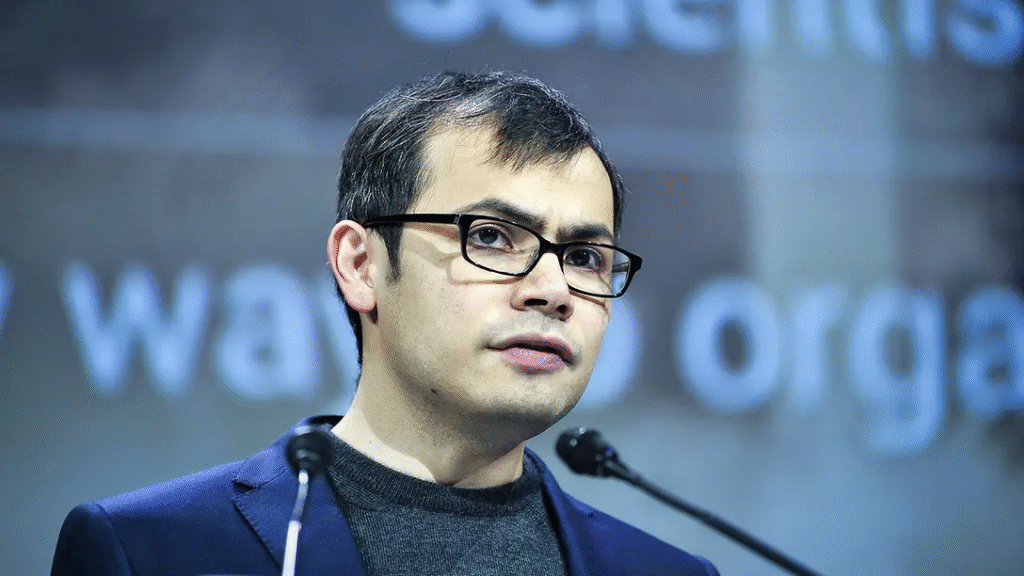
When Demis Hassabis, CEO of Google DeepMind and fresh Nobel Prize winner, stepped up to deliver his Nobel lecture, he knew he wanted to follow tradition. “I felt that it’s sort of a tradition of Nobel Prize lectures that you’re supposed to be a little bit provocative,” he explained in a recent conversation.
His provocation? A mind-bending conjecture that any pattern that can be generated or found in nature can be efficiently discovered and modeled by a classical learning algorithm.
Think about that for a moment. We’re talking about biology, chemistry, physics, maybe even cosmology and neuroscience – everything from protein folding to planetary orbits to the shape of mountains. According to this brilliant mind who’s already revolutionized AI multiple times over, classical computers running neural networks should be able to model it all.
But here’s the thing – he might actually be right. in a recent podcast he shared his brilliant and mondoboggling perspective on AI. Lets dive deep.
From Game Designer to Universe Decoder
Before we dive into this wild theory, you need to understand something about Hassabis. This isn’t just another tech CEO making bold claims. This is the guy who designed legendary video games like Theme Park and Black & White in the 1990s, then pivoted to neuroscience, got a PhD studying memory and imagination, and then built DeepMind into the most scientifically impactful AI company in the world.
His journey from game designer to Nobel laureate isn’t just inspiring – it’s actually the key to understanding his revolutionary approach to AI.
“Games were my first love really, and doing AI for games was the first thing I did professionally in my teenage years,” he shared. Those early days of creating open-world simulations where players co-create their experience? That was preparation for something much bigger.
The Pattern Behind Everything
So what exactly is Hassabis talking about with this “any pattern in nature” claim? The insight comes from looking at what DeepMind has already accomplished.
Take AlphaGo conquering the ancient game of Go – a game with more possible positions than there are atoms in the observable universe. Or consider AlphaFold solving protein folding, a problem that stumped scientists for decades. In both cases, what looked impossibly complex became tractable once you built the right model.
“Proteins fold in milliseconds in our bodies,” Hassabis points out. “So somehow physics solves this problem that we’ve now also solved computationally.”
His insight? Natural systems have structure because they were shaped by evolutionary processes. Mountains get their shapes from weathering over thousands of years. Planetary orbits are sculpted by gravitational forces acting over cosmic time. Even the elements we see around us exist because they’re the stable ones that survived various selection pressures.
“If that’s true, then you can maybe learn what that structure is,” he explains. It’s like nature is doing a search process, and that search process creates systems that can be efficiently rediscovered.
Why This Changes Everything
This isn’t just philosophical speculation. Hassabis and his team have been proving this conjecture piece by piece. AlphaFold didn’t just solve one protein – it predicted the structure of virtually every protein known to science. AlphaFold 3 now handles the incredibly complex interactions between proteins, RNA, and DNA.
But here’s where it gets really interesting. Look at what their video generation model Veo can do – it’s modeling physics, lighting, fluid dynamics, and materials with stunning accuracy. “I used to write physics engines and graphics engines in my early days in gaming, and I know it’s just so painstakingly hard to build programs that can do that,” Hassabis marvels.
Yet somehow, Veo learned all this just from watching YouTube videos. It’s extracting underlying structure about how materials behave, how liquids flow, how light interacts with surfaces – all the complex physics that traditionally required enormous computational resources to simulate.
The P vs NP Revolution Hiding in Plain Sight
For the computer science geeks out there, Hassabis is essentially proposing a new complexity class. He’s working on this in his spare time with colleagues – the idea that there might be a whole new category of problems solvable by neural network processes, specifically those that map onto natural systems with evolved structure.
“I think information is primary,” he explains. “Information is the most fundamental unit of the universe, more fundamental than energy and matter.” If you think of the universe as an informational system, then the P = NP question becomes a physics question.
This could be the key to understanding not just what classical computers can do, but what they fundamentally cannot do. The things that might remain hard? Abstract problems like factoring large numbers, where there might not be natural patterns to learn from.
What This Means for Science
The implications are staggering. If Hassabis is right, we’re looking at a future where AI can help us understand cellular biology, predict weather with unprecedented accuracy, design new materials, and maybe even tackle the origin of life itself.
“I always wanted to do [AGI] for… to help us as scientists answer these questions like P = NP,” he says. The goal isn’t just to build smart machines – it’s to use them as the ultimate scientific instruments.
Consider what’s already happening:
- Weather prediction systems that outperform traditional fluid dynamics models
- Material discovery that could lead to room-temperature superconductors
- Drug design through companies like Isomorphic Labs, spun out from AlphaFold research
- Fusion reactor optimization helping with plasma containment
The Gaming Connection That Explains Everything
Here’s something most people miss about Hassabis – his gaming background is actually crucial to understanding his approach to AI. Those open-world games he designed in the ’90s were essentially early simulations where emergent behavior arose from relatively simple rules.
“I always used to love making open-world games where there’s a simulation and then there’s AI characters, and then the player interacts with that simulation and the simulation adapts to the way the player plays,” he explains.
Sound familiar? That’s exactly what modern AI systems do – they create models of complex environments that can adapt and generate new scenarios.
Now imagine that concept scaled up with today’s AI capabilities. Hassabis envisions future games where AI can “truly create around your imagination” and “dynamically change the story and storytelling around and make it dramatic no matter what you end up choosing.”
The Road to AGI Through Science
What makes Hassabis different from other AI leaders is his conviction that the path to Artificial General Intelligence runs directly through scientific discovery. While others focus on scaling compute or improving language models, he’s using AI to tackle humanity’s biggest scientific challenges.
His definition of AGI? Systems that can match all the cognitive functions of the human brain consistently across domains. Not the jagged intelligence we see today, where systems excel at some things but fail at others.
The test won’t just be performance on thousands of cognitive tasks. Hassabis is looking for “lighthouse moments” – like inventing a new scientific conjecture the way Einstein did, or creating a game as elegant and deep as Go.
“Can it invent a new conjecture or new hypothesis about physics like Einstein did?” he asks. “Another one would be can it invent a game like Go – not just come up with move 37, a new strategy, but can it invent a game that’s as deep, as aesthetically beautiful, as elegant as Go?”
The Energy Equation That Changes Everything
One of the most compelling aspects of Hassabis’s vision is how solving AI leads directly to solving humanity’s energy crisis. Through better materials science, fusion reactor design, and grid optimization, AI could make energy essentially free and renewable.
“If energy is kind of free and renewable and clean, then that solves a whole bunch of other problems,” he points out. Water access through desalination, unlimited rocket fuel from splitting seawater, asteroid mining – the cascade effects of abundant clean energy would be transformational.
His prediction? “I would not be that surprised if there was a like 100-year time scale from here” to becoming a Type 1 Kardashev scale civilization – one that can harness all the energy available on its planet.
The Consciousness Question That Keeps Him Up at Night
For all his confidence about modeling natural patterns, Hassabis remains beautifully humble about the deeper mysteries. The hard problem of consciousness – how information “feels” when we process it – still fascinates him.
“One of the best definitions I like of consciousness is it’s the information feels when we process it,” he says. But he admits it’s “not a very helpful scientific explanation.”
His approach? Keep building AI systems and comparing them to human minds to see what the differences are. Maybe through brain-computer interfaces, we’ll eventually be able to feel what it’s like to compute on silicon rather than carbon.
The Beautiful Mess We’re In
What gives Hassabis hope for humanity’s future? Our “almost limitless ingenuity” and “extreme adaptability.” We’re already adapting to AI technology that would have seemed impossible just years ago.
“How is it we can cope with the modern world with effectively our hunter-gatherer brains?” he marvels. “Flying on planes, doing podcasts, playing computer games and virtual simulations… Society’s already adapted to this mind-blowing AI technology we have today.”
His vision for the future isn’t just about building smarter machines. It’s about using those machines to unlock the fundamental patterns that govern everything from subatomic particles to galactic clusters – and in doing so, helping humanity flourish among the stars.
The Bottom Line
Demis Hassabis isn’t just building AI – he’s using AI to decode the universe itself. His conjecture that any natural pattern can be efficiently modeled by classical learning algorithms isn’t just academic speculation. It’s a roadmap for using artificial intelligence to solve humanity’s greatest challenges.
From protein folding to fusion energy, from weather prediction to the origin of life, the patterns are there waiting to be discovered. And if Hassabis is right, we already have the tools to find them.
The question isn’t whether this vision will come to pass. The question is how quickly we can make it happen – and whether we’ll be wise enough to steward these powerful technologies safely into the world.
What patterns in nature do you think AI will crack next? And are you ready for a world where the fundamental mysteries of physics become as solvable as predicting your next move in a video game?
Demis Hassabis leads Google DeepMind and recently won the Nobel Prize in Chemistry for AlphaFold’s breakthrough in protein structure prediction. His work continues to push the boundaries of what’s possible when you combine deep learning with scientific discovery.