So, your mom asked, “Beta, what is this vector embedding you keep talking about?”
And instead of saying “Arey Maa, it’s complicated,” let’s make it simple. Like masala dosa simple.
TL;DR for Busy Moms
- Vector embedding = turning words into smart numbers
- Similar words → similar numbers
- Used in Google, ChatGPT, Netflix, everywhere
- And yes, it’s more useful than your cousin’s MBA
What Are Vector Embeddings?
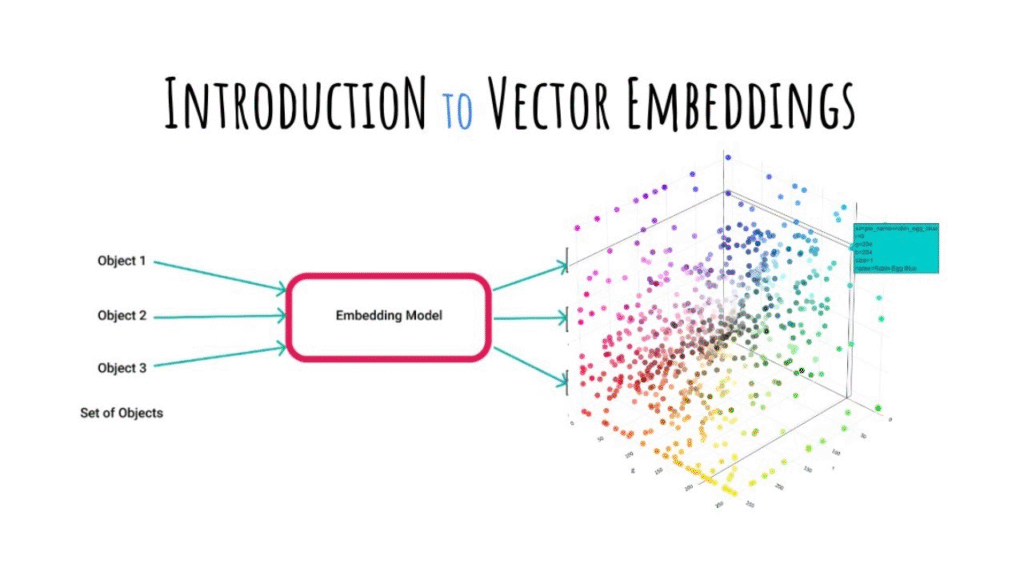
In short: Vector embeddings are how computers understand words.
Humans use language.
Computers use numbers.
So, we have to teach the computer how to feel the meaning of words — using maths.
This is where vector embeddings come in.
Words into Numbers – But Smartly!
Imagine you tell your mom:
“Maa, I like biryani.”
Now, instead of just reading the word biryani, the computer converts it into a list of numbers. Like:
Biryani → [0.25, -0.13, 0.99, …]
Same with other words:
Pulao → [0.24, -0.10, 1.01, …]
See how close the numbers are?
So the computer says, “Aha! Biryani and Pulao are similar!”
Basically, words that mean similar things have similar number patterns.
That’s the magic of vector embeddings.
Analogy Time – The Dabba Analogy
Words are like lunch boxes (dabbas).
Each dabba looks different from outside – but we care about what’s inside.
Now suppose:
- Dabba 1 has: Rice, Chicken, Masala → “Biryani”
- Dabba 2 has: Rice, Veggies, Spices → “Pulao”
- Dabba 3 has: Chocolate, Cream → “Pastry”
Vector embeddings are like a scanner that looks inside the dabba, not just the label.
So, it knows Biryani and Pulao are close cousins.
Pastry? Total outsider. Sweet guy, but doesn’t belong here.
But Why So Much Maths?
Simple. Computers don’t get “feelings” or “taste”.
So, we convert feelings of words into maths.
Once we do that, we can ask computers to:
- Suggest similar words
- Translate languages
- Write essays (like I’m doing now)
- Even crack jokes (sometimes bad ones)
Okay, But Where Do These Numbers Come From?
We don’t make them manually.
We show the computer huge amounts of text – like books, Wikipedia, WhatsApp forwards… (okay, maybe not WhatsApp).
The model learns patterns like:
- “King” is to “Queen” as “Man” is to “Woman”
- “Mumbai” is to “Maharashtra” as “Chennai” is to “Tamil Nadu”
It figures this out on its own.
Very studious fellow, this AI.
Final Thoughts – From Mom to Matrix
So next time your mom says:
“Why are you always on laptop, haan?”
Tell her:
“Maa, I’m teaching machines to understand feelings of words. In numbers. Like biryani and pulao!”
She might still shake her head, but deep down, she’ll be proud. 😄
Want to impress your mom even more?
Teach her cosine similarity next time. But only after chai. ☕