How a geeky AI company name became the search engine that’s giving Google sleepless nights.
The Name That Almost Killed a Billion-Dollar Dream
You know that feeling when you hear a company name and think, “There’s no way I’m remembering this”? Well, that’s exactly what happened with Perplexity. Even employees at organizations using the platform struggle with the name – some just call it “PEX” to avoid the tongue-twister.
But here’s the thing – behind this seemingly impossible-to-pronounce name lies one of the most fascinating startup stories in AI today. And quite frankly, the founder knows it’s a terrible name for a consumer company.
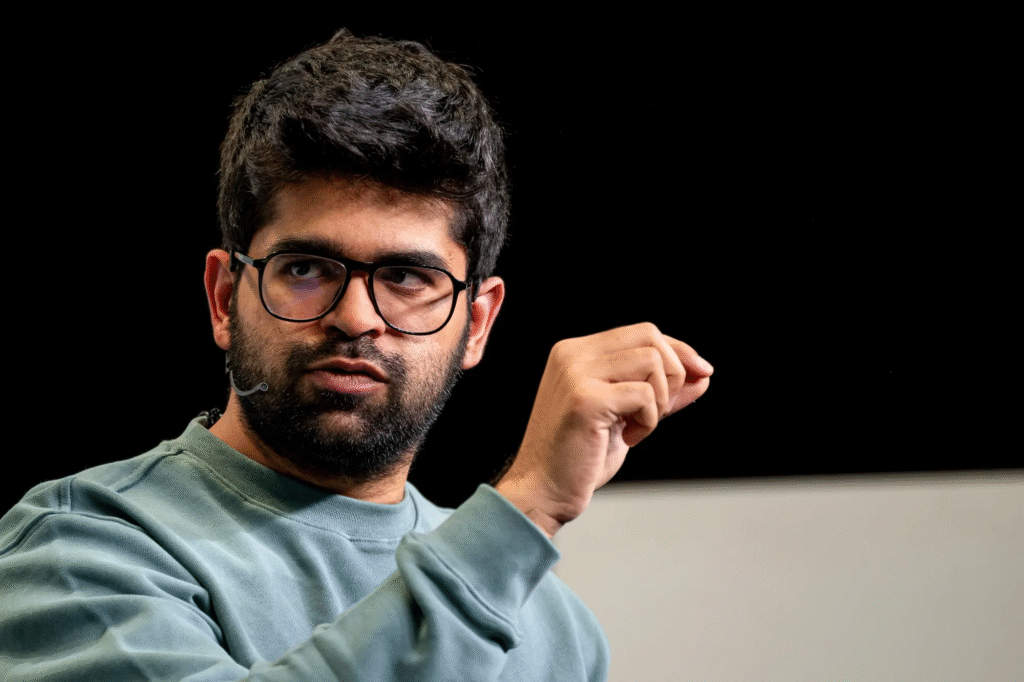
Aravind Srinivas, Perplexity’s founder, admits it straight up: “It’s one of the worst names you can pick for a consumer company. I’m 100% aware of it.” But there’s actually a pretty interesting story behind why he chose it.
When You Have $120 and Big Dreams
Back when Srinivas was starting out, he didn’t have much money. No funding, no clear vision of building a billion-user product. He just knew he wanted to do something in search and create unique experiences that weren’t possible before.
“When you pick a name for the company, you pick something pretty cool and easy to get a domain for,” he explains. “Perplexity.ai was available for $120 for 2 years, so I just got it.”
The name itself comes from AI terminology – perplexity is actually a metric that measures how well an AI model understands something. Pretty geeky, right? But that $120 domain decision would eventually become the foundation of a company that’s now challenging Google itself.
The Jeff Bezos Connection That Changed Everything
Now here’s where the story gets really interesting. How do you go from being a startup founder with a difficult-to-pronounce company name to having Jeff Bezos personally invest in your company?
The approach was brilliant in its simplicity. Srinivas reached out through a common contact, and Bezos’s team responded asking for a memo – because, well, Bezos loves his memos.
But Srinivas didn’t just send any ordinary memo. He created something special: an imaginary demo of Jeff Bezos himself talking to Perplexity’s voice system, asking questions about Star Trek and Blue Origin. He recorded it himself and sent it along with the written memo.
The result? Bezos approved the investment without even meeting Srinivas first. Just based on the memo and that creative demo.
What Bezos Really Thinks About Success
After subsequent meetings with Bezos (yes, they’ve met multiple times), Srinivas shares some incredible insights about what makes the Amazon founder special.
The most powerful piece of advice Bezos gave him? “Your success doesn’t rely on Google’s failure.” This perspective shift was huge – instead of focusing on beating the competition, focus on serving customers better.
Bezos also emphasized something crucial for any growing startup: retention over growth. “Don’t be a leaky bucket,” he said. “Make sure that as you grow, your retention is only increasing, not even staying flat.”
But what really impressed Srinivas about Bezos was his clarity of thought and decision-making frameworks. “There’s a reason that it’s not easy to be truth-seeking – by nature, human beings are not truth-seeking animals. We are social animals. We like validation,” Bezos explained in one of their conversations.
How Perplexity Actually Works (The Simple Version)
So how does Perplexity give you answers when you type in a question? It’s actually quite fascinating when you break it down.
Here’s what happens behind the scenes:
When you ask a question, Perplexity pulls up relevant results from their index and looks at ranking signals from multiple search engines. They combine all this using their own algorithm, then let their AI model read through all those links, extract relevant information, and write a synthesized answer with proper citations.
The real magic happens in the orchestration – filtering out low-quality domains, personalizing based on your location and past queries, and re-ranking the final set of links. Most of the quality improvements actually come from better link selection rather than just having a smarter AI model.
The interesting part? If you and your friend search for the same thing from the same location, you’ll probably get very similar answers. Any differences are usually because of A/B tests the company runs to improve the product.
The Three Industries AI Will Transform First
According to Srinivas, three sectors are going to benefit massively from AI adoption:
- Software Development – AI is already changing how code gets written
- Healthcare – Diagnostics and treatment recommendations are getting smarter
- Financial Consulting – Data analysis and insights are becoming more sophisticated
The Craziest Search Query Ever
Running a search engine means you see some pretty wild queries. The most ridiculous one Srinivas remembers? Someone asking for face protection that would cover their nose with holes for eyes and still allow breathing – basically describing a ski mask. The search intent was clearly suspicious, making it seem like “this person is trying to rob a bank.”
What’s Next: The Voice Revolution
Looking ahead, Srinivas believes the next generation of search won’t be about typing queries into a box. It’ll be about having conversations with AI, asking questions through voice, and getting tasks done seamlessly.
“I hope there are multiple players there,” he says about the future landscape. “Google will certainly be one of them, OpenAI will be one of them. We hope to be one of them. Meta is likely to be one of them, XAI too.”
The Regret Minimization Framework
One of the most powerful concepts Srinivas learned from studying Bezos is the “regret minimization framework.” The idea is simple: when making big decisions, imagine yourself at 80 years old looking back – what would you regret not trying?
This framework played a huge role in his decision to start Perplexity. At 30, he was already conscious that his cognitive abilities were declining from their peak (those days of cramming 10 lectures in 3 hours before an exam were behind him). The choice was clear: start now or regret it later.
The Bottom Line
Perplexity’s story shows us something important about startups: sometimes the best ideas come from the simplest observations. Srinivas saw that existing search engines weren’t giving people the conversational, intelligent answers they actually wanted. So he built something better.
Yes, the name is terrible for a consumer company. But the product? It’s making Google nervous enough that they’re rapidly pushing their own AI search features.
And honestly, when Jeff Bezos is investing in your “difficult-to-pronounce” startup and spending personal time understanding your strategy, you know you’re onto something big.
What do you think – will AI search engines like Perplexity eventually replace traditional Google search? Or will Google adapt fast enough to maintain their dominance?
Want to try Perplexity for yourself? Just remember – it’s spelled P-E-R-P-L-E-X-I-T-Y. Though honestly, the founder won’t blame you if you just bookmark it instead.