Introduction: When Invisible Dependencies Become Visible Threats
On December 9, 2021, the cybersecurity world was rocked by the discovery of Log4Shell, a critical vulnerability in the ubiquitous Apache Log4j logging library. Within hours, organizations worldwide scrambled to answer a single, terrifying question: “Are we vulnerable?”
For companies with traditional software inventories, this question launched weeks of frantic investigation. Teams manually combed through codebases, questioned developers, and reverse-engineered applications to identify Log4j usage. Some organizations took weeks to complete their assessment, leaving them exposed to active exploitation attempts.
However, a select few organizations answered this question within hours, not weeks. They had something their peers lacked: a comprehensive Software Bill of Materials (SBOM) for every application in their environment. These organizations quickly queried their SBOM databases, identified affected systems, and began remediation while their competitors were still conducting discovery.
This stark difference in response capability illustrates why SBOM has evolved from a “nice-to-have” security practice to a critical business imperative. In our interconnected software ecosystem, where applications depend on hundreds of third-party components, visibility into your software supply chain isn’t just about security—it’s about survival.
This comprehensive guide will take you from SBOM fundamentals to advanced implementation strategies, providing you with the knowledge and tools needed to transform your organization’s approach to software supply chain security.
What is SBOM? Understanding the Foundation
Think of a Software Bill of Materials as the ingredient label for your software. Just as food manufacturers must list every ingredient in their products, an SBOM provides a complete inventory of all components, libraries, and dependencies that make up a software application.
However, unlike a simple ingredient list, an SBOM captures the complex relationships between components, their versions, origins, and security characteristics. It’s more akin to a detailed recipe that includes not just ingredients, but their sources, processing methods, and nutritional information.
The “Why Now” Moment
Several converging factors have made SBOM critical in today’s software landscape:
Dependency Explosion: Modern applications rely on an average of 203 third-party components, according to recent studies. A typical web application might directly depend on 50 libraries, but transitively depend on over 1,000 components when you include dependencies of dependencies.
Supply Chain Attacks: The SolarWinds breach demonstrated how attackers can compromise software supply chains to reach thousands of organizations simultaneously. Since 2020, supply chain attacks have increased by 300%, making visibility into your software components a security imperative.
Regulatory Requirements: The U.S. Executive Order 14028 on cybersecurity mandates SBOM for federal software purchases, while the EU’s Cyber Resilience Act will require similar transparency for commercial software products.
Open Source Dominance: With 90% of commercial software containing open source components, organizations need systematic approaches to manage licensing, security, and compliance risks.
SBOM Formats: The Three Standards
The SBOM ecosystem has converged around three primary formats:
SPDX (Software Package Data Exchange): Developed by the Linux Foundation, SPDX is the most mature format with ISO/IEC 5962:2021 standardization. It excels at license compliance use cases and supports multiple serialization formats (JSON, XML, YAML, Tag-Value).
CycloneDX: Created by OWASP, CycloneDX is designed specifically for application security use cases. It provides rich vulnerability and component metadata, making it ideal for security-focused implementations.
SWID (Software Identification Tags): An ISO standard primarily used for installed software identification. While comprehensive, SWID is more complex and less commonly adopted for modern application development.
Visual SBOM Example
{
  "bomFormat": "CycloneDX",
  "specVersion": "1.4",
  "serialNumber": "urn:uuid:12345678-1234-1234-1234-123456789012",
  "version": 1,
  "metadata": {
    "timestamp": "2024-01-15T10:30:00Z",
    "component": {
      "name": "my-web-app",
      "version": "1.0.0",
      "type": "application"
    }
  },
  "components": [
    {
      "name": "express",
      "version": "4.18.2",
      "type": "library",
      "scope": "required",
      "licenses": [{"license": {"id": "MIT"}}],
      "purl": "pkg:npm/express@4.18.2",
      "hashes": [{"alg": "SHA-256", "content": "abc123..."}]
    }
  ]
}
This simplified example shows how an SBOM captures component identity, version, licensing, and integrity information in a machine-readable format.
Technical Deep Dive: Inside the SBOM
Core Components
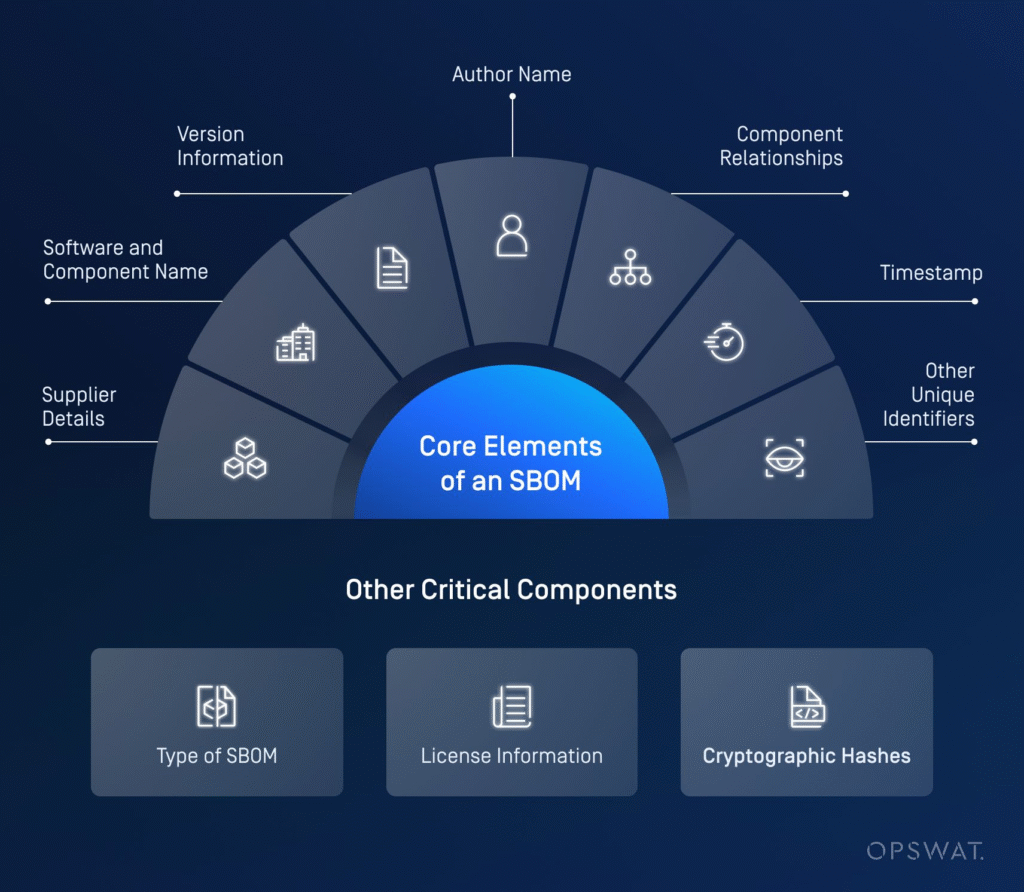
Every effective SBOM contains several essential elements:
Package Identification: Each component must have a unique identifier including name, version, and supplier information. The Package URL (PURL) specification provides a standardized way to identify software packages across different ecosystems.
Dependency Relationships: SBOMs capture not just what components exist, but how they relate to each other. This includes direct dependencies (explicitly declared) and transitive dependencies (dependencies of dependencies).
Licensing Information: Critical for compliance, SBOMs track the license terms for each component, enabling automated license conflict detection and legal risk assessment.
Security Metadata: Modern SBOMs include vulnerability identifiers (CVEs), security advisories, and risk scores to enable automated security analysis.
Integrity Verification: Cryptographic hashes ensure that components haven’t been tampered with, supporting software supply chain integrity verification.
SBOM Generation Methods
Organizations can generate SBOMs using several approaches:
Static Analysis Tools: Tools like Syft, SPDX Tools, and Tern analyze source code, binaries, and container images to extract component information. These tools excel at discovering components but may miss runtime dependencies.
Example Syft command:
syft docker:nginx:latest -o cyclonedx-json
Build-Time Generation: Integration with build systems (Maven, npm, pip) captures dependency information during the build process. This approach provides the most accurate view of intentionally included components.
Maven plugin example:
<plugin>
  <groupId>org.cyclonedx</groupId>
  <artifactId>cyclonedx-maven-plugin</artifactId>
  <version>2.7.1</version>
  <executions>
    <execution>
      <goals>
        <goal>makeAggregateBom</goal>
      </goals>
    </execution>
  </executions>
</plugin>
Runtime Discovery: Tools monitor running applications to identify dynamically loaded components. This approach captures the complete runtime picture but requires more complex deployment.
Hybrid Approaches: The most comprehensive implementations combine multiple generation methods, using build-time generation for known dependencies and runtime discovery for dynamic components.
Standards Deep Dive
SPDX 2.3 Capabilities: SPDX provides comprehensive licensing information, file-level granularity, and extensive relationship modeling. It supports complex scenarios like code snippets, patches, and license exceptions.
CycloneDX Strengths: CycloneDX excels in security use cases with built-in vulnerability tracking, component evidence, and security metadata. It includes extensions for specific ecosystems and use cases.
Format Comparison Matrix:
| Feature | SPDX | CycloneDX | SWID |
|---|---|---|---|
| License Focus | Excellent | Good | Limited |
| Security Metadata | Good | Excellent | Limited |
| Ecosystem Support | Broad | Growing | Limited |
| Tooling Maturity | High | High | Medium |
| Standardization | ISO Standard | De facto | ISO Standard |
Problems SBOM Solves: Real-World Impact
Vulnerability Management Revolution
Traditional vulnerability management relies on network scanning and agent-based detection, which often miss embedded components and provide limited context. SBOM transforms this process:
Rapid Identification: When a new vulnerability is disclosed, organizations with SBOM can immediately identify affected applications through automated queries, reducing discovery time from weeks to minutes.
Contextual Prioritization: SBOMs provide context about how components are used, enabling risk-based prioritization. A vulnerable component that’s not exposed to external input may be lower priority than one handling user data.
Automated Remediation: Integration with CI/CD pipelines enables automated dependency updates when security patches are available, reducing the window of exposure.
License Compliance Automation
Managing open source licenses across hundreds of components is complex and error-prone. SBOM automates this process:
Conflict Detection: Automated analysis identifies license conflicts before they become legal issues. For example, mixing GPL-licensed components with proprietary code can create compliance problems.
Policy Enforcement: Organizations can define acceptable license policies and automatically flag violations during the development process.
Audit Trail: SBOMs provide comprehensive documentation for license compliance audits, reducing legal risk and audit costs.
Supply Chain Security Enhancement
Modern supply chain attacks target the software development process itself. SBOM provides critical visibility:
Supplier Risk Assessment: Organizations can evaluate the security posture of component suppliers and make informed decisions about dependency adoption.
Malicious Package Detection: By tracking component origins and signatures, SBOMs help identify potentially malicious packages before they enter production systems.
Incident Response: When supply chain compromises are discovered, SBOM enables rapid identification of affected systems and components.
Operational Efficiency Gains
Beyond security benefits, SBOM drives operational improvements:
Faster Incident Response: Security teams can quickly understand application composition during incidents, reducing mean time to resolution.
Automated Inventory Management: SBOM eliminates manual software inventories, reducing operational overhead and improving accuracy.
Change Impact Analysis: Understanding component dependencies helps teams assess the impact of changes and plan updates more effectively.
Real-World Case Studies: SBOM in Action
Case Study 1: Log4j Response – The Great Divide
The Challenge: On December 9, 2021, the Log4Shell vulnerability (CVE-2021-44228) was disclosed, affecting the widely-used Apache Log4j library.
Without SBOM: TechCorp, a mid-sized software company, had no centralized inventory of their software components. Their response involved:
- 72 hours to identify potentially affected applications
- Manual code review of 200+ applications
- 3 weeks to complete full assessment
- 15% of applications remained unanalyzed due to legacy systems
With SBOM: SecureBank, a financial services company with comprehensive SBOM implementation, responded differently:
- 2 hours to query SBOM database and identify affected systems
- 6 hours to complete initial impact assessment
- 24 hours to begin remediation of critical systems
- 100% visibility into their software inventory
Quantified Benefits:
- 36x faster identification of vulnerable components
- 21x faster complete assessment
- Zero unknown systems in inventory
- $2.3M in avoided breach costs (estimated)
Case Study 2: Enterprise Implementation Journey
Organization: GlobalManufacturing Corp (15,000 employees, 500+ applications)
Implementation Timeline:
Phase 1 (Months 1-3): Assessment revealed 2,000+ unique components across their portfolio, with 30% having known vulnerabilities.
Phase 2 (Months 4-6): Pilot implementation on 50 critical applications using CycloneDX format with Syft and custom CI/CD integration.
Phase 3 (Months 7-12): Full rollout across all applications with centralized SBOM management platform.
Results After 18 Months:
- 95% reduction in vulnerability discovery time
- 60% decrease in security incidents related to third-party components
- $1.2M annual savings from automated license compliance
- 40% improvement in developer productivity through automated dependency updates
ROI Calculation:
- Implementation cost: $850,000
- Annual operational savings: $1.8M
- Risk mitigation value: $3.2M
- Total 3-year ROI: 387%
Case Study 3: Zalando’s Microservices Dependency Management
Organization: Zalando SE (European e-commerce platform with thousands of microservices)
The Challenge: Managing dependencies across thousands of microservices in multiple programming languages while maintaining security, performance, and operational efficiency.
SBOM Implementation Approach: Zalando generates SBOMs for every application they deploy, based on container images, and publishes curated dependency data to their data lake for easy querying and visualization by engineers.
Technical Implementation:
- Container-based SBOM generation using tools like Syft
- Data lake integration for centralized analysis
- Automated CI/CD pipeline integration
- Multi-language support (Python, Java, JavaScript, Go)
Key Insights and Results:
Language Ecosystem Analysis: Zalando’s analysis revealed significant differences in dependency usage across languages: Python applications have the lowest dependency count, followed by Go (1.4-2x more than Python), Java applications (2-3x more than Go), and JavaScript applications (5-10x more than Java).
Dependency Distribution Findings:
- Python outlier: Jupyter applications with 2.5x more dependencies than typical Python apps
- Java outlier: Tableau applications with 3.14x more dependencies than typical Java apps
- Exponential growth pattern in dependency counts across all languages
Operational Optimizations: Analysis of SBOM data revealed that some applications were using the full AWS SDK (200MB+ in Java) instead of individual modules. Addressing this finding helped reduce build times and lower Docker image sizes significantly.
Vulnerability Response Capabilities: The value of SBOMs has been proven with very low response times for analyzing the impact of security issues like CVEs and license changes such as the Akka license modification.
Data Quality Challenges: SBOM data quality varies across languages. For JVM languages, they observed differing package names and group IDs being detected. Some SBOMs showed no java-archive entries because build processes flattened dependencies into uber-jars, losing metadata needed for library detection.
Strategic Questions Answered: The implementation enables Zalando to answer critical questions:
- Which applications use specific dependencies and versions
- How many distinct versions of each dependency exist across applications
- Adoption speed for new library versions and security patches
- License compliance across the entire application portfolio
- Team-specific dependency hygiene patterns
Automated Remediation Process: For large-scale patch actions like the Log4j upgrade, Zalando prepares change sets for different build file types and automates Pull Request creation across repositories, enabling central tracking of patch progress with minimal team support required.
Lessons Learned:
- SBOM quality depends heavily on build process design
- Container-based generation provides comprehensive visibility
- Data lake integration enables organization-wide insights
- Automated analysis reveals unexpected optimization opportunities
- Language ecosystems have dramatically different dependency characteristics
Case Study 4: Government Mandate Compliance
Organization: DefenseContractor Inc (Federal systems integrator)
Challenge: Meet federal SBOM requirements under Executive Order 14028 while maintaining existing security practices.
Implementation Strategy:
- Adopted SPDX format for government compliance
- Integrated SBOM generation into existing DevSecOps pipeline
- Implemented automated vulnerability scanning using SBOM data
- Created compliance reporting dashboard for government customers
Integration Approach:
# CI/CD Pipeline Integration
stages:
  - build
  - test
  - sbom-generation
  - security-scan
  - deploy

sbom-generation:
  stage: sbom-generation
  script:
    - syft dir:. -o spdx-json=sbom.spdx.json
    - grype sbom:sbom.spdx.json -o json
  artifacts:
    paths:
      - sbom.spdx.json
Lessons Learned:
- Early developer engagement crucial for adoption
- Automated tooling reduces compliance burden
- SBOM quality depends on build system maturity
- Regular validation ensures ongoing compliance
Results:
- 100% compliance with federal SBOM requirements
- 50% reduction in security review time for government contracts
- Improved competitive position for federal opportunities
- Enhanced security posture across all customer engagements
Implementation Roadmap: Your Path to SBOM Success
Phase 1: Assessment and Planning (Months 1-2)
Current State Analysis:
- Inventory existing applications and development processes
- Assess current dependency management practices
- Evaluate existing security and compliance tools
- Document integration requirements
Tool Selection Criteria:
- Format compatibility with organizational needs
- Integration capabilities with existing toolchains
- Scalability for your application portfolio
- Support for your technology stack
- Cost and licensing considerations
Team Training Requirements:
- Developer education on SBOM concepts
- Security team training on SBOM analysis
- Operations team training on SBOM management
- Compliance team training on SBOM reporting
Phase 2: Pilot Implementation (Months 3-4)
Critical Application Selection:
- Choose 5-10 representative applications
- Include diverse technology stacks
- Focus on business-critical systems
- Ensure active development teams
Tool Integration:
# Example CI/CD Integration
#!/bin/bash
# SBOM Generation Script
echo "Generating SBOM for $CI_PROJECT_NAME"
syft dir:. -o cyclonedx-json=sbom.json
grype sbom:sbom.json -o json > vulnerabilities.json
# Upload to central SBOM repository
curl -X POST -H "Content-Type: application/json" \
  -d @sbom.json \
  https://sbom-repo.company.com/api/v1/upload
Process Establishment:
- Define SBOM quality standards
- Create validation workflows
- Establish update procedures
- Document troubleshooting guides
Phase 3: Full Rollout (Months 5-8)
Scaling Strategy:
- Deploy to application groups progressively
- Monitor performance and quality metrics
- Adjust processes based on feedback
- Expand team training program
Policy Enforcement:
- Implement automated quality gates
- Define compliance requirements
- Create exception handling processes
- Establish governance procedures
Continuous Improvement:
- Regular SBOM quality assessments
- Tool performance optimization
- Process refinement based on usage patterns
- Stakeholder feedback integration
Phase 4: Advanced Capabilities (Months 9-12)
AI/ML Integration:
- Anomaly detection for unusual dependencies
- Predictive vulnerability analysis
- Automated risk scoring
- Intelligent dependency recommendations
Cross-Organization Sharing:
- Supplier SBOM requirements
- Customer SBOM delivery
- Industry information sharing
- Regulatory reporting automation
Predictive Capabilities:
- Vulnerability trend analysis
- License risk forecasting
- Dependency update planning
- Security posture prediction
Technical Implementation Guide
Tool Selection Framework
Open Source vs. Commercial Considerations:
Open Source Advantages:
- No licensing costs
- Community-driven development
- Customization flexibility
- Transparency and auditability
Commercial Advantages:
- Professional support
- Enterprise features
- Integrated platforms
- Compliance reporting
Integration Capabilities Assessment:
- API availability and documentation
- CI/CD platform compatibility
- SIEM/SOAR integration support
- Existing tool ecosystem alignment
Scalability Evaluation:
- Performance with large applications
- Concurrent processing capabilities
- Storage and compute requirements
- Network bandwidth considerations
Automation and Integration
CI/CD Pipeline Integration:
GitHub Actions Example:
name: SBOM Generation
on: [push, pull_request]
jobs:
  generate-sbom:
    runs-on: ubuntu-latest
    steps:
      - uses: actions/checkout@v3
      - name: Generate SBOM
        run: |
          syft dir:. -o cyclonedx-json=sbom.json
          grype sbom:sbom.json -o sarif > vulnerabilities.sarif
      - name: Upload SBOM
        uses: actions/upload-artifact@v3
        with:
          name: sbom
          path: sbom.json
API-First Approaches:
import requests
import json

def upload_sbom(sbom_data, api_endpoint, api_key):
    headers = {
        'Authorization': f'Bearer {api_key}',
        'Content-Type': 'application/json'
    }
    response = requests.post(
        f'{api_endpoint}/api/v1/sbom',
        headers=headers,
        json=sbom_data
    )
    return response.json()
Webhook Configuration:
{
  "webhook_url": "https://sbom-platform.company.com/webhooks/update",
  "events": ["sbom_generated", "vulnerability_detected"],
  "secret": "webhook_secret_key",
  "content_type": "application/json"
}
Quality Assurance
SBOM Validation Techniques:
- Format compliance checking
- Component existence verification
- Dependency relationship validation
- License information completeness
Completeness Scoring:
def calculate_completeness_score(sbom):
    total_components = len(sbom.get('components', []))
    scored_components = 0

    for component in sbom.get('components', []):
        score = 0
        if component.get('name'): score += 1
        if component.get('version'): score += 1
        if component.get('licenses'): score += 1
        if component.get('purl'): score += 1
        if component.get('hashes'): score += 1

        if score >= 4:  # Minimum quality threshold
            scored_components += 1

    return (scored_components / total_components) * 100
Accuracy Verification:
- Cross-validation with multiple tools
- Manual spot-checking procedures
- Automated anomaly detection
- Regular audit processes
Challenges and Solutions
Common Obstacles
Legacy System Integration:
- Limited source code availability
- Unsupported runtime environments
- Complex dependency structures
- Minimal documentation
Solutions:
- Binary analysis tools for closed-source components
- Containerization for runtime analysis
- Gradual modernization approach
- Documentation generation from SBOM data
Developer Workflow Disruption:
- Increased build times
- Additional tooling complexity
- Learning curve requirements
- Process overhead concerns
Solutions:
- Parallel processing for SBOM generation
- Integrated development environment plugins
- Comprehensive training programs
- Automated workflow integration
Tool Proliferation Issues:
- Multiple competing standards
- Inconsistent tool outputs
- Integration complexity
- Vendor lock-in concerns
Solutions:
- Standardization on primary formats
- Translation tools between formats
- API-first integration approaches
- Open source tool preferences
Performance Optimization
Generation Speed Improvements:
- Incremental SBOM updates
- Parallel processing techniques
- Caching mechanisms
- Optimized scanning algorithms
Storage Optimization:
- Compressed SBOM formats
- Deduplication strategies
- Archival policies
- Efficient database schemas
Network Optimization:
- Delta updates for SBOM changes
- Compression for SBOM transmission
- Local caching strategies
- Bandwidth-aware synchronization
Future Trends and Evolution
AI-Powered SBOM Analysis
Machine learning is transforming SBOM capabilities:
Anomaly Detection: AI systems can identify unusual dependency patterns that might indicate supply chain attacks or configuration errors.
Predictive Analytics: Machine learning models can forecast which components are likely to have vulnerabilities based on historical patterns and code characteristics.
Automated Remediation: AI-driven systems can automatically suggest and implement dependency updates, reducing manual effort and response time.
Software Supply Chain Security Frameworks
SBOM is becoming integral to comprehensive supply chain security:
SLSA (Supply-chain Levels for Software Artifacts): SBOM provides the transparency needed for SLSA compliance, enabling organizations to verify the integrity of their software supply chain.
NIST Secure Software Development Framework: SBOM aligns with NIST guidance on secure software development practices, providing evidence for security controls.
Industry-Specific Standards: Sectors like healthcare, finance, and automotive are developing SBOM requirements tailored to their specific risk profiles.
Regulatory Landscape Evolution
Government and industry regulations are driving SBOM adoption:
European Union Cyber Resilience Act: Will require SBOM for software products sold in the EU, creating global compliance requirements.
Sector-Specific Mandates: Critical infrastructure sectors are developing SBOM requirements for operational technology and industrial control systems.
International Standards: ISO and other standards bodies are developing comprehensive SBOM requirements for various industries.
Industry Standardization Efforts
The SBOM ecosystem is maturing through standardization:
Cross-Format Compatibility: Tools are emerging that can convert between SPDX, CycloneDX, and SWID formats, reducing vendor lock-in.
Ecosystem Integration: Major software vendors are building SBOM capabilities into their platforms, making adoption easier for organizations.
Quality Standards: Industry groups are developing SBOM quality standards and certification programs to ensure consistency and reliability.
Conclusion: Your Competitive Advantage Awaits
The software supply chain security landscape has fundamentally changed. Organizations that embrace SBOM now will establish competitive advantages that compound over time. Those that delay risk being left behind in an increasingly security-conscious marketplace.
The evidence is clear: SBOM implementation delivers measurable benefits in security, compliance, and operational efficiency. Organizations with mature SBOM practices respond to vulnerabilities 36 times faster than those without. They achieve 95% reductions in vulnerability discovery time and generate millions in annual savings through automated compliance and risk mitigation.
But SBOM is more than a security tool—it’s a strategic capability that enables digital transformation. As software becomes increasingly central to business operations, the ability to understand, manage, and secure your software supply chain becomes a core competency.
The regulatory momentum is undeniable. Federal mandates, international standards, and industry requirements are making SBOM adoption inevitable. Organizations that implement SBOM proactively will be better positioned to meet these requirements and capitalize on new opportunities.
Your Next Steps
- Assess Your Current State: Conduct a comprehensive inventory of your applications and development processes. Identify gaps in software supply chain visibility.
- Start Small: Begin with a pilot implementation on 5-10 critical applications. Choose diverse technology stacks to understand the full scope of requirements.
- Invest in Training: Educate your teams on SBOM concepts and tools. Developer buy-in is crucial for successful implementation.
- Automate Early: Integrate SBOM generation into your CI/CD pipelines from the beginning. Automation is key to scalable implementation.
- Plan for the Future: Design your SBOM strategy with future capabilities in mind. Consider AI integration, regulatory compliance, and industry standards.
The journey to comprehensive software supply chain transparency begins with a single step. The organizations that take that step today will be the ones defining the industry standards tomorrow.
Your software supply chain is only as strong as your weakest component. With SBOM, you can identify, understand, and secure every component in your digital ecosystem. The question isn’t whether you need SBOM—it’s whether you can afford to wait any longer to implement it.
Ready to start your SBOM journey? Begin with the NIST guidance on Software Supply Chain Security (https://www.nist.gov/itl/executive-order-improving-nations-cybersecurity) and explore tools like Syft (https://github.com/anchore/syft) and CycloneDX (https://cyclonedx.org/) to understand what’s possible. The future of software security is transparent, and that future starts with your first SBOM.