The story of how messy tech companies are becoming super organized—and what it means for everyone
The Big Mess in Tech Companies
As you might already know, my daily job is to secure the digital products that keep IKEA safely running its business. That really is a great privilege. But the real fun is in the number of products that I have to deal with. It’s massive. The problem is even bigger. A product might have ‘n’ number of components, each having an autonomous team with a varied tech stack. Some teams might be spinning up Kubernetes clusters while some teams are busy building APIs while others are just continuously shipping features. The scale is 120+ such products consisting of people, process, culture and tech. It’s crazy, right!
Let me tell you about an even crazier scenario that I have to face every day. The first rule of security is to know “What we have” to clearly know “what we need to secure.” You can now easily imagine how hard it is to know “What all do we have?” Even if we are somehow able to get the answers through a magic globe, we still have another problem. At the end of the day, as a security person, I might receive a vulnerable endpoint that needs to get fixed immediately. But then I need to know “Who owns this and who else can help to fix this!” In a giant company like IKEA, it is similar to searching for a needle in a haystack.
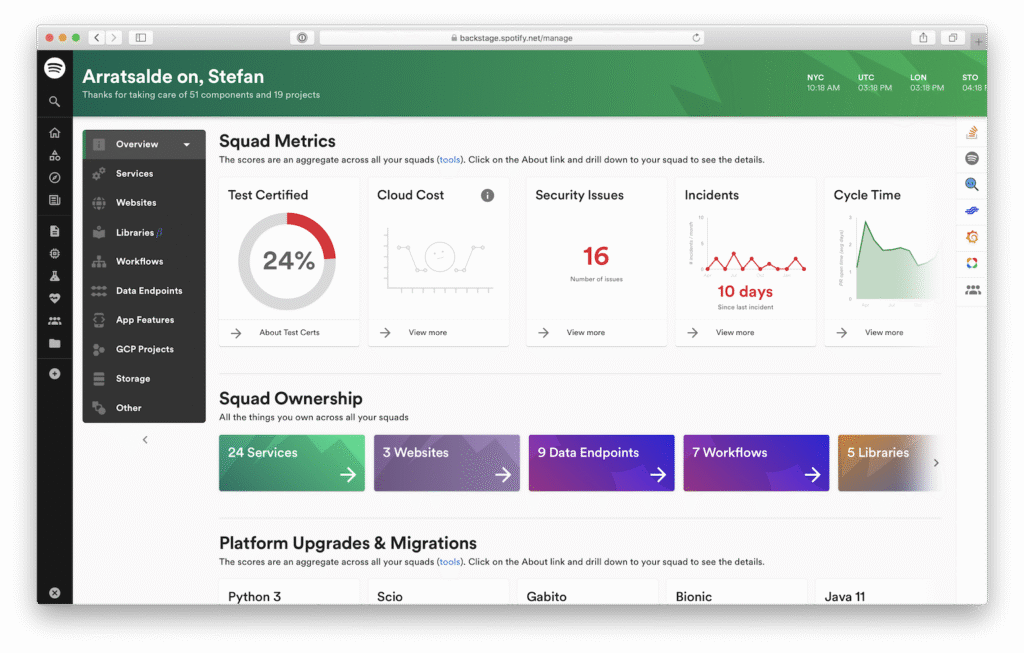
So is our security program doomed? Not really. This is the story of almost every tech giant. Spotify had a similar problem too, and they came up with Backstage, which is an Internal Developer Platform, specially designed to find the needle in the haystack in no time. But how? Let’s go back to their story on how they came up with this solution.
The Spotify Story: From Chaos to Order
Yes I know, when I said spotify you imagined their music app.
Eight years ago, a guy named Stefan worked there. When Spotify’s music stopped working at night, he got emergency phone calls. His job was to fix things fast like every other support guy in the IT world.
No prize for guessing the problem? He usually couldn’t fix things alone. He needed help from other teams. But again, finding the right person to help was like looking for someone in a huge city without street signs (Not haystack again!).
So Spotify built what Stefan calls a “phone book”—a simple list of who was responsible for what.
But then they realized they needed more than just phone numbers. They needed to know:
- Who built what
- How different parts worked together
- What tools everyone was using
- How to build new things the right way
So their simple phone book grew into something much bigger. They called it Backstage.
Over time, Backstage became like a control center for their entire tech team. Today, it has over 100 different tools built into it and it became their real game changing Platform which was accelerting their Enginnering excelence. The world then slowly took a step forward towards “Platform Engineering”. Lets understand it more deeply.
What Platform Engineering Really Is
This approach has a fancy name: Platform Engineering. But what does it actually mean?
Think of it like building a city.
Without Platform Engineering, every team builds their own house however they want. Some use wood, some use brick, some use metal. None of the houses connect to the same power lines or water pipes. When something breaks, nobody knows who to call.
With Platform Engineering, everyone builds houses using the same basic design. All houses connect to the same power, water, and internet. There are clear rules about how to build safely. When something breaks, there’s a clear system for fixing it.
Platform Engineering creates shared tools and rules that make everyone’s job easier. These brought some masiive changes but lets talk about the most important three changes.
The Three Big Changes
Change 1: From Hero Mode to Team Mode
Old way: Every programmer had to learn everything or need to know whom to connect for what. if they needed to put their app on the internet? Learn server management or connect to the right team. Want to make it secure? Learn cybersecurity or connect to the right team. Want to track if it’s working? Learn monitoring systems or connect with SRE team.
New way: Most of this stuff is handled automatically by the platform now. Devs can focus on building cool features instead of managing complicated technical stuff.
Change 2: From Separate Teams Fighting to Everyone Working Together
Old way:
- Development team: “We need to move fast!”
- Security team: “Stop! That’s not secure!”
- Operations team: “Stop! That will break everything!”
- Everyone argues and nothing gets done quickly.
New way: The platform automatically handles security and reliability. Development teams can move fast because safety is built into the system. (Sounds like DevOps ?)
Change 3: From Fixing Problems to Preventing Problems
Old way: Wait for something to break, then scramble to fix it.
New way: The platform watches everything and warns you before problems happen. It can even fix some problems automatically.
This 3 changes was drastically changing the devlopers experice and the wait time for every of this yak shaving started reducing exponentially. It was a game changer for security team as well.

How This Changes Security and Operations
Security Gets Easier
Instead of security experts checking every project by hand (which takes weeks), security rules get built into the platform. When someone creates a new app, it’s automatically secure by default.
It’s like having safety features built into every car instead of having to remember to wear a seatbelt.
Operations Becomes Automatic
Instead of experts manually setting up servers and deployment systems for every project, the platform does it automatically. Click a button, and your app goes live safely.(journey from DevOps to ClickOps)
It’s like having an automatic transmission instead of having to know how to use a clutch. but .. but … but here comes the AI.
Enter AI: When Platforms Get Smart
Now here’s where it gets really interesting. Companies are starting to add AI to their platforms.
AI Assistant: Your Smart Helper
Spotify built something called AiKA. It’s like having a really smart coworker who has read all your company’s documentation and remembers everything.
Instead of spending hours searching through documents to figure out how to do something, you just ask: “How do I upgrade to the new recommendation system?”
The AI reads all the docs instantly and gives you step-by-step instructions.
AI Automation: Work That Does Itself
But it gets even better. The AI is learning to do simple tasks automatically:
- Update old code to use new, better versions
- Fix security problems without human help
- Predict when systems might break and fix them first
- Deploy new features safely without human oversight
The Bigger Picture: Why This Matters
Think about how cities made civilization possible. Before cities, humans lived in small groups. It was hard to specialize—everyone had to know how to hunt, grow food, make clothes, and build shelter.
Cities let people specialize. Some became farmers, some became blacksmiths, some became merchants. Everyone got better at their specific job, and society as a whole became more advanced.
Platform Engineering does the same thing for tech companies.
Before Platform Engineering:
- Every programmer spent 70% of their time on boring technical setup
- Teams couldn’t easily work together
- Building new features took forever
- Most work was just maintaining old systems
After Platform Engineering:
- Programmers spend most of their time building cool new features
- Teams can easily share and build on each other’s work
- New ideas can be tested quickly
- Most maintenance happens automatically
Real Results from Real Companies
PagerDuty (a company that helps other companies handle emergencies) tried this approach. Here’s what happened:
- Building new services got 3x faster (from 75 hours to 25 hours)
- New employees became productive immediately instead of spending weeks learning systems
- Major technical upgrades became easy instead of taking months of coordination
When they switched to Spotify’s managed platform (called Portal), they said: “We can focus on our actual business instead of maintaining internal tools.”
What’s Coming Next
The future looks pretty amazing:
Smart Platforms That Learn
Platforms will watch how teams work and automatically improve themselves. If lots of people are struggling with something, the platform will figure out how to make it easier.
AI Teammates
Instead of AI just answering questions, it will actively help with work. It might automatically update your code, fix problems while you sleep, or suggest better ways to build features.
Everything Connected
All the tools teams use will work together seamlessly. No more switching between 20 different apps to get work done.
Why This Matters for Everyone
Even if you’re not a programmer, this affects you:
Better apps and websites: When programmers can focus on building cool features instead of fighting with technical complexity, you get better products.
Faster innovation: New ideas can be tested and launched much faster.
More reliable technology: Automated systems are better at preventing problems than humans working manually.
Lower costs: Companies can build more with smaller teams, which usually means lower prices for users.
The Bottom Line
Platform Engineering is like giving every tech team a set of superpowers. Instead of every person having to be an expert in everything, they can focus on what they’re best at while the platform handles the rest.
Adding AI to these platforms is like giving those superpowers an upgrade. The platform doesn’t just provide tools—it becomes a smart teammate that can think, learn, and work alongside humans.
We’re moving from a world where building software is hard, slow, and frustrating to a world where good ideas can become real products quickly and reliably.
The companies that figure this out first will build better products faster than their competitors. And everyone else—from app users to website visitors—will benefit from the results.
The future of tech isn’t about individual genius programmers working alone. It’s about smart platforms that help entire teams work together more effectively than ever before.
And that future is happening right now.